
Dataset Engineering for Workplace LLMs
How to Teach a Generic AI Model Your Work... for GPT, Claude, Copilot, Gemini, etc.

A generic model such as GPT or Claude already knows how to write, summarize, classify, reason, and generate code. What it does not know is how your organization wants those tasks performed.
It does not automatically know your preferred report structure, internal terminology, escalation rules, risk categories, compliance requirements, or definition of a good answer. Those behaviors must be demonstrated through instructions, examples, and evaluation.
That is where dataset engineering comes in.

Dataset engineering is the process of collecting, cleaning, formatting, and organizing examples that teach or test the behavior you want from an AI system.
Even if you never train a foundation model from scratch, you still need dataset engineering when you:
Create examples for a prompt
Build an evaluation set
Prepare data for fine-tuning
Test a RAG system
Teach an agent how to use tools
Compare different models or workflows
The quality of the final system depends heavily on the quality of these examples. A larger dataset does not automatically produce a better result. A smaller set of carefully selected examples can be far more useful than thousands of inconsistent ones.
Different Datasets (for LLMs)
The word dataset can refer to several different things in an AI application.
A RAG knowledge base might contain policies, research reports, contracts, product documentation, and other factual sources. Its purpose is to give the model information.
A fine-tuning dataset usually contains examples of inputs and desired outputs. Its purpose is to teach the model how to behave.
An evaluation dataset contains test cases and expected outcomes. Its purpose is to determine whether the system is working.
These datasets may come from the same business process, but they are not interchangeable.
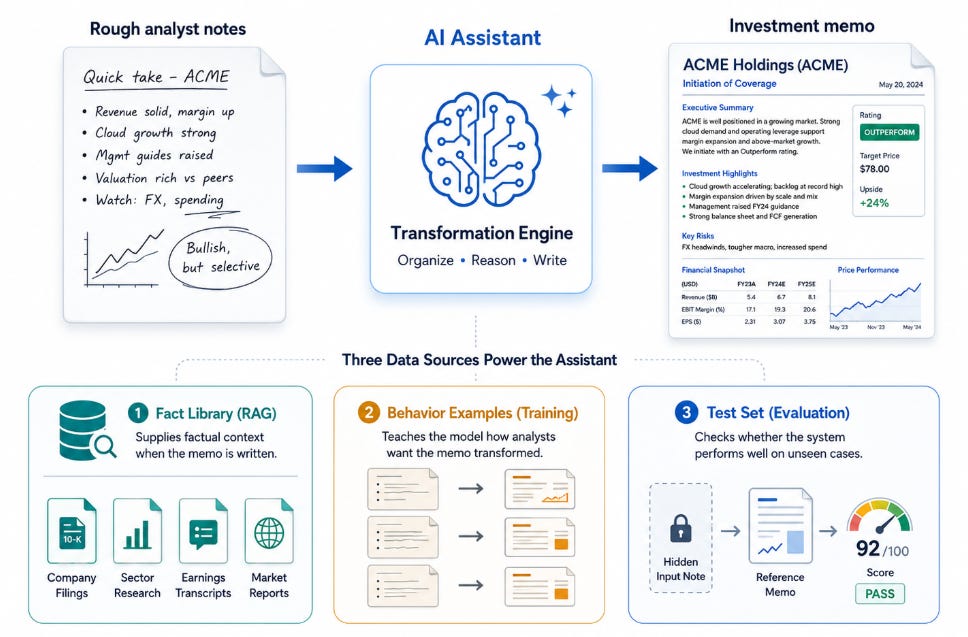
Consider an AI assistant that turns rough analyst notes into investment memos… The company’s research archive belongs in the RAG system because it contains factual information the model may need.
A collection of approved analyst notes paired with completed investment memos belongs in the fine-tuning dataset because it demonstrates the desired transformation.
A separate set of notes and expected memos should be reserved for evaluation. A useful rule is: RAG provides facts. Training examples demonstrate behavior. Evaluation data measures performance.
Start With the Behavior You Want
A common mistake is to begin with whatever data happens to be available. Instead, start by defining the task. Suppose you want an AI assistant to review internal project proposals. Before collecting examples, decide what a good response should contain.
Should the model:
Summarize the proposal
Identify financial and operational risks
Separate facts from assumptions
Flag missing information
Recommend a next step
Follow a specific report structure
These requirements determine what your dataset must demonstrate.
If your examples contain only summaries, the model will not learn how to identify risks. If the examples use different report structures, the model may produce inconsistent outputs. If some examples provide cautious recommendations while others make unsupported conclusions, the model will learn both behaviors.
Training data should exhibit the behavior you want the model to reproduce.
This sounds obvious, but many poor datasets are simply collections of historical outputs without any examination of whether those outputs are actually good.
The 3 Main Dataset Requirements
A useful dataset needs three things:
Data quality
Data coverage
Sufficient quantity
Quantity matters, but it comes after quality and coverage.
Data quality
High-quality examples should be relevant, aligned with the task, consistent, correctly formatted, sufficiently unique, and compliant with applicable policies.
Relevant: The example should resemble the work the model will perform.
A dataset of general business writing may not help a model produce your company’s investment memos. A collection of public legal documents may not teach it how your legal department reviews commercial contracts.
Aligned with the task: The expected answer should reward the behavior you actually want.
If the goal is concise executive summaries, the approved outputs should be concise. If the model must justify every risk rating, the examples should contain both the rating and its justification. An answer can be factually correct while still being misaligned with the task.
Consistent: Similar inputs should receive outputs of similar quality and structure.
If two reviewers would score the same response very differently, the model receives a noisy training signal. This often happens when the organization has not defined what a good answer looks like.
Correctly formatted: Examples should follow the same format the production system expects.
Remove irrelevant HTML, duplicated headers, inconsistent whitespace, broken characters, and unnecessary metadata. Standardize dates, currencies, labels, field names, and capitalization.
Formatting errors can quickly become learned behaviors.
Sufficiently unique: Repeated examples can distort the dataset.
If one type of request appears hundreds of times while another appears only twice, the model may overfit to the repeated pattern. Deduplication should remove exact duplicates and review near-duplicates that teach essentially the same lesson.
Compliant: Do not place data into a training or evaluation pipeline simply because it is technically accessible.
Remove information that you are not authorized to use, including personal information, confidential client data, credentials, and restricted internal material. Record where the data came from and what it may be used for.
Data coverage (Data Diversity)
A dataset must cover the range of situations the model will face.
Users rarely phrase the same request in the same way. Some provide detailed instructions. Others provide one vague sentence. Some use internal abbreviations, make spelling mistakes, attach incomplete information, or ask several questions at once.
Your dataset should reflect this variation. For an AI system that reviews expense requests, coverage might include:
Complete and incomplete submissions
Valid and invalid expenses
Different departments and expense categories
Ambiguous requests requiring clarification
Unusual but legitimate exceptions
Requests that should be escalated
Attempts to bypass company policy
Coverage should also reflect differences in output difficulty. Do not build a dataset containing only easy examples and expect the model to handle complex edge cases.
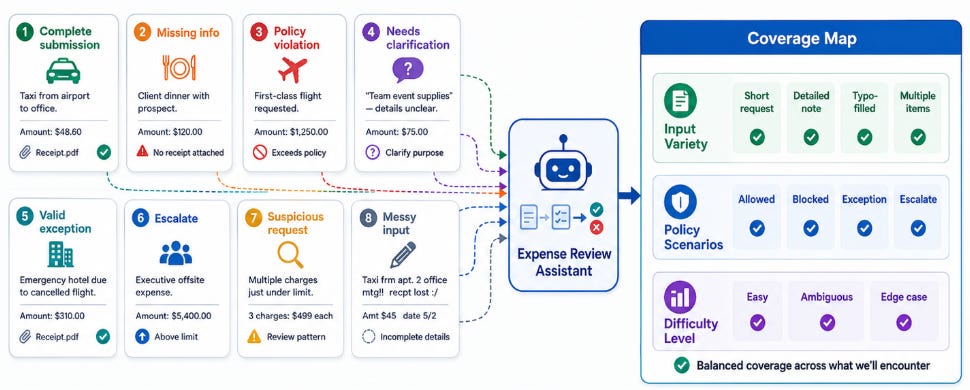
The goal is not maximum diversity for its own sake. The goal is representative diversity. Adding unrelated examples can make the dataset larger without making it more useful.
Choose the Right Data Format
The structure of the dataset should match the behavior being taught.
Single-turn examples
Single-turn data contains one request and one response.
This works well for tasks such as:
Classifying a support ticket
Rewriting a paragraph
Extracting fields from a document
Converting text into JSON
Generating a standard report
A typical example might contain:
Input:
Summarize the following risk report for senior management.

Expected output:
A concise summary using the company’s standard risk categories and escalation format.
Multi-turn examples
Multi-turn data is needed when the model must manage an interaction rather than answer a single request.
For example, the model may need to:
Identify that information is missing
Ask a clarifying question
Incorporate the user’s response
Complete the task
A dataset containing only single-turn answers may teach the model to guess instead of asking for missing information.
Tool-use examples
An AI agent may need to search a database, retrieve a document, run a calculation, or call an internal API.
Tool-use data should demonstrate:
When a tool should be used
Which tool should be selected
Which parameters should be supplied
How the tool output should be interpreted
When the model should stop using tools
When human approval is required
The most important examples are often not successful tool calls. They are the ambiguous and unsafe cases in which the model should ask for clarification, refuse an action, or escalate to a human.
Preference examples
Sometimes several responses are technically acceptable, but one is better aligned with the organization’s preferences. In that case, the dataset can include a request, a preferred response, and a less desirable response.
This can teach distinctions such as:
Concise versus unnecessarily verbose
Cautious versus overly confident
Direct versus evasive
Useful versus technically correct but irrelevant
Compliant versus policy-violating
The differences between the two responses should be clear. Arbitrary preferences create a noisy signal.
Build the Dataset From Real Work
The most useful examples usually come from the workflow the AI system will support.
Start with real requests, documents, and outputs from the intended users. Then review them before adding them to the dataset.
Historical work is not automatically good training data. It may contain outdated procedures, inconsistent formatting, weak analysis, or shortcuts that should not be reproduced.
A practical collection process is:
Gather representative real-world inputs.
Remove sensitive or unauthorized information.
Group the inputs by task, difficulty, and failure mode.
Create or approve the desired output for each input.
Standardize the format.
Review examples for consistency.
remove duplicates and low-value examples.
Reserve a separate set for evaluation.

Domain experts should be involved in this process. They understand which details matter, which mistakes are serious, and what a usable output looks like.
However, asking experts how they perform a task is not always enough. People often skip steps when explaining familiar work.
Keep Training and Evaluation Data Separate
Do not evaluate the system using the same examples that were used to teach it.
A model can perform well on familiar examples while failing on new ones. This creates the appearance of improvement without demonstrating that the system can generalize.
Maintain at least two sets:
Development data: Used to write prompts, create examples, fine-tune the model, and improve the workflow.
Evaluation data: Held back and used to measure performance on unseen cases.
The evaluation set should resemble production traffic and include important edge cases. It should also remain stable enough that results can be compared across model versions, prompt changes, and fine-tuning runs.
When a failure from the evaluation set is added to the training data, replace it with a new unseen evaluation case. Otherwise, the test gradually becomes part of the training process.
Use Failure Analysis
Dataset development should be driven by observed failures. When the model produces a bad answer, classify the failure before adding more data.
Was the answer wrong because the model lacked information?
That may be a RAG problem.
Was the information available, but the model ignored the required format?
That may be a behavioral problem suitable for better examples or fine-tuning.
Did the model misunderstand an ambiguous request?
Add examples that demonstrate when to ask for clarification.
Did it perform well on common cases but fail on exceptions?
Expand coverage around those exceptions.
Did it produce inconsistent answers?
Review whether the training examples themselves are inconsistent.
The objective is not to accumulate data. It is to reduce identifiable failure modes.
Version the Dataset Like Code
A production dataset should not be treated as a static spreadsheet that people edit without tracking changes.
Record:
Where each example came from
Who approved it
When it was added
Which policy or workflow version it reflects
Whether it contains synthetic content
Which model or prompt was evaluated against it
Why it was changed or removed
Dataset versions should be connected to model and prompt versions.
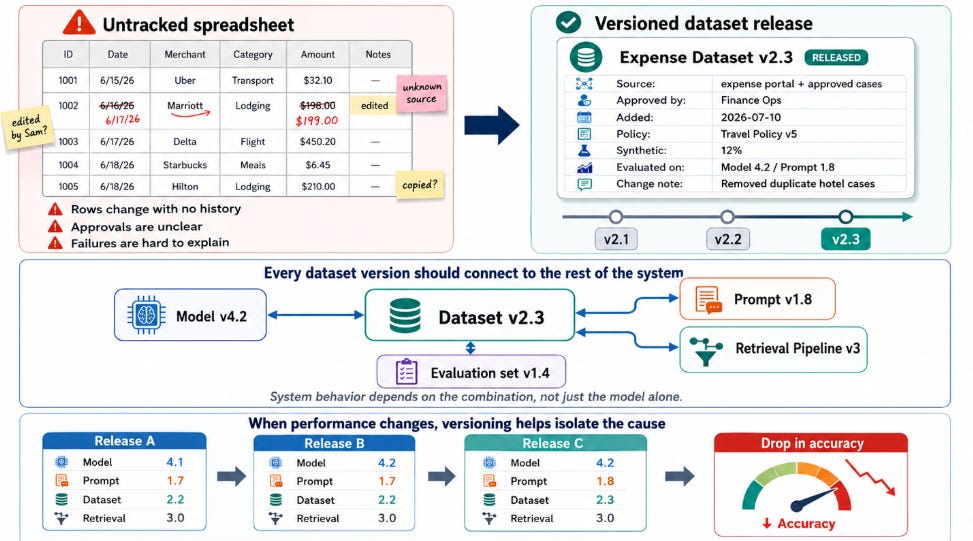
When system performance changes, you should be able to determine whether the cause was the model, the prompt, the retrieval pipeline, or the data.
Without versioning, improvements become difficult to reproduce and regressions become difficult to diagnose.